


Dignity of Risk: Andrea's MAGNIficent 2 Race Report
Updated: Mar 24
It’s hard to know where to start… This isn’t a typical race report. Part recap, part therapy session. And, at over 4,000 words, I didn’t actually include everything. In fact, with every proofreading, I want to add more!
It’s now about 2 weeks after the The MAGNIficent 2, a 6 1/2 day adventure race on the South Island of New Zealand. Moments of fear, exhaustion, and exhilaration have begun to settle into casual afterthoughts, but a clear theme has emerged for me. In short, there is a beauty in being gifted the dignity of risk.

A Year Ago:
This is the second time team thisABILITY raced The MAGNIficent Adventure Race in NZ. Last year, we botched the strategy and had a great experience, but a poor ranking left us wanting a do-over. After the finish of that brutal race, my first call home left me in tears.
My 24-year-old son, Trey, who has Down syndrome, had been taken to the ER with possibilities of seizures while I was racing. The family had gone through some traumatic events, and we all wished I had been there. The burden lay on Trey’s dad and his sisters. It was scary. While I wouldn’t have been able to change the circumstance, I would have been able to share the load, the decision-making, and the real-time heartache of seeing someone you love turn into someone you hardly recognize. (Hang in there, this eventually relates to this year’s MAGNIficent.)
The Year Between: Injuries, Challenges, and Recovery
Fast forward a year. Both Trey and I have been through a NOT-so-fabulous year. I broke both my tibia and fibula in May while mountain biking on one of our home trails. As we were trying to address Trey’s issues, I needed more help than ever. Surgery (8 screws and a plate), crutches, and 6 weeks of non-weight bearing made me doubt that I would ever be able to do the things I loved to do… and especially to the extent that I had been doing them.

I usually forget just how hard it is to complete an expedition, but there was no denying how hard it was to take even one step without pain and limping. I was out for two big races, and my FOMO made me realize just how much adventure racing meant to me.
Slowly but surely, I forced myself to override the doubt and the depression. My kids and Chip came to my aid. I was probably spoiled, but I was in too much of a funk to fully appreciate it. Simultaneously, we were navigating “the system” and a variety of medications to try to both diagnose and treat Trey’s new OCD behaviors and, for lack of another term, “weirdness.” Both of us were not ourselves for quite a while.
Nevertheless, life was lived, and day by day, things got better. I started walking again, then riding a bike, then headed out on the trail. Trey was diagnosed with hyperthyroidism, and treatment for that began. He started enjoying things again that he had abandoned, like coloring and working out using the Supernatural app on the Oculus headset.
We were, and are, concurrently working toward becoming better versions of ourselves. Trey wouldn’t say it like that. In fact, he would prefer NO change… at all… ever. I used to think that would be nice. But, as we all know, change is the only guarantee in life.
With Trey getting closer to his “normal", we have decided it is time to help him take the next step in independence. We are in the process of helping him move into a Supported Living Apartment.
There are times when this decision takes my breath away. I think of all the terrible things that can happen in an unpredictable world, where it’s sometimes easier to see the worst in people than to envision a natural network of support. I think about just how much help Trey needs and how it won’t be me who provides that help… even though I’m the one who can understand him, I’m the one who can communicate for him, and I’m the one who can protect him… or so I tell myself.
The truth is, however, with someone always protecting you,
there is little room for growth.
The MAGNIficent 2:
Back to the race… The race directors of the MAGNIficent are known to produce extremely challenging races. Their race in the US, Expedition Oregon, is referred to as America’s Toughest Race, and I don’t think I’ve ever heard anyone disagree. A hallmark of their races is the opportunity to test your technical skills. Your team may even find yourselves in a scenario where you need to decide together if the challenge at hand is above your collective ability or not.
In the adventure racing world, it’s a little controversial. Is it the race director’s job to make sure the course is safe, or is it the team’s job to make sure they can safely do the course? I'll let you be the judge of how the Magness team would answer that.
Urban Portage:
I’d say the first taste of something spicy in the MAGNIficent 2 was the urban portage during the first packraft stage (Stage 2 – The Mighty Mataura, 35 km/22 miles). We came to a portion of the Mataura River where there is a concrete weir in the middle of some abandoned factories. There was an enlarged map of this area, and the portage was marked with a race flag. Two safety people were also on hand to point out the correct way to go.
We climbed down the dam that was taller than me, crossed the river hauling our packrafts over slippery rocks, and down-climbed some huge boulders that were sculpted by water and time. It was a mix of natural beauty and industrial ruins, and it was more of a puzzle than a clear path. Caution was needed, but risk remained in check.


Hardest Bikewhack Ever:
The next section of the race that was clearly a Magness race feature was the hike-a-bike down a gully during the 3rd leg of the race (Stage 3 – Vexed in Venlaw, 110 km/68.35 miles, 3000 m/9843 ft). We’d made it through the first few stages without incident. It was day two, and we had not slept yet.
Chip helped carry some of my gear, but to my surprise, my ankle wasn’t holding us back very much. I’d even had a surge of power in the middle of the night as I rode the trail with ease up to the high trig point while the guys hiked their bikes. But, alas, everything is temporary, and the feeling didn’t last… The upcoming hike-a-bike just about broke me.
It could arguably have been the hardest 6 hours of a race I’ve ever done, and that’s saying a lot! As suggested, we loosened our handlebars and turned them 90 degrees to be in line with the bike. It was awkward, but definitely helped get through those tight squeezes.
We didn’t remove our pedals, though, and my shins paid the price. I also didn’t put on my shin guards nor take the seat bag off my bike until we were at least halfway down. Dumb. Both of those things made a big difference, and I should’ve taken the time to do it earlier. Why did I wait?!
Bashing through the thick jungle on a VERY steep incline felt next to impossible. We meandered to and from the small stream in the reentrant, over and under trees and roots, with nothing being easy, dry, or remotely flat. Being the slowest on the team in this section did not help my morale either.
There were short sections where help was greatly appreciated, but for the most part, we all had to get our own selves and our bikes through this mess.
At one point, my bad ankle was stuck in mud nearly up to my knee and at an odd angle. I tried to pull my foot out and could feel my shoe starting to slide off. I was stuck. I cursed. I cried. I let myself experience the panic that was rising.
All the while, Chip was right beside me telling me it was going to be okay. That phrase, even though I have trained him over years to say it, still felt good to hear. I think he knew better than to laugh, but in hindsight, it must have been at least a little amusing to see me basically throw a fit, something I’m definitely not proud of and is pretty out of character for me. Nick and David kept quiet. None of us were exactly having fun.
All I could think of in the moment was that I’d heard of people who lost a shoe to mud and never got it back. Getting down this gully with no shoe would be the end of my race, all to complete this stupidest of all stupid bike carries ever. (Nevermind that Gen X fear of death by quicksand. Ha!)
Obviously, I got my foot out, quit crying, and moved on. It took us over 5 hours to go a little over 1 km (.6 miles). I’d say we had a little luck on our side, too. With all of that abuse, our derailleurs remained intact and our bikes were rideable afterward, even caked in mud.
It very well may have been the dumbest hike-a-bike ever, but I’m not going to say I’m not glad I did it. Yep, that double negative means I’m glad I did it. I’m sure it will make all future similar efforts seem easy, since everything is always relative. (It even made that Morocco hike-a-bike down a canyon seem easy.)
So, for that, I suppose I’m grateful. And… let’s just say, I knew what I signed up for. We know several of the Magness team tested this section out. They knew what they were asking racers to do.
Meanwhile, the other option was riding around for 50+ km (31 miles) with 1500 m (4920 ft) elevation gain. It would have probably been faster. Who would’ve thought!?

The Hardest Treks Ever:
Both big treks, the first in the thick jungle and the second in the swampy highlands, were also classic Magness race features. These treks were BIG, and navigation needed to be BOLD.
We needed to shorten both by skipping several propoints (worth 10 points each compared to the 100-point CPs) and some orienteering points (worth one point each) to stay on track with completing the course on time. We were essentially moving about a kilometer an hour in these stages.
We set off for our first point in the Catlins trek (Stage 4 – The Tautuku Trek, 24 km/15 miles, 1200 m / 3937 ft elevation gain) on a bearing for 800 meters through neck-high foliage of ferns, vines, and towering moss-covered trees. It was right out of Jurassic Park.
There were no trails and no “elephant tracks” showing us where other teams had gone. It was dark, and the undulating terrain required consideration as to whether the hills and depressions were even big enough to show up on the map. Twenty-meter contour lines make that determination tricky. Wandering in circles for hours was not beyond imagination.
After an early bobble on the first point, we got back on track. It was all hands on deck. (Side note: Supposedly, this point of the trek was the first mistake in 5 years made by Chris Forne, the best navigator in the world, who has won 7 World Championships.)

Similarly, the Blue Mountain trek in the highlands (Stage 8 – Blue Mountain Bush Bash, 30 km/19 miles, 2000 m / 6562 ft elevation gain) also required solid navigation in seriously challenging terrain. Gone were the towering trees, but chest-high bush was still the name of the game. The racer guide refers to this trek as having sections of “diabolically difficult travel.” I concur.
“Swimming” through tussock grasses and yucca-like plants, we tried to avoid any boggy holes underfoot. The key word there is ‘tried’. I don’t think any of us avoided the holes altogether.
It always seems strange to experience swamps on top of mountains. Tarns (small alpine lakes) littered the mountaintop, and it was swampy and moss-covered in places. It was completely different than any other section of the race.
About midway through this leg, we found ourselves in a pickle. Reality wasn’t lining up with the map, and the further we went, the more likely we would become completely disoriented. It was nearing 4 a.m., so we opted to return to a known location and sleep until sunrise. What a great decision that was!
We had a fabulous three hours of sleep on top of white, fluffy moss that was dry on top, despite growing in one of the wettest environments. When the sun rose, we realized our attack point was slightly off. We regrouped and had no issues after that.
Side note: We got about 13.5hours of sleep total during the race that took us 6 days and 11 hours and 19 minutes to finish.


The Scariest Leg Ever:
So far, I’ve mentioned things we expect from a Magness race that highlight technical challenges with inherent risk: the portage, the hike-a-bike, and the remote navigation with unrelenting terrain. But, the coasteering section (Stage 6 – Catlins Coasteering Challenge, 12 km/7.46 miles, 400m/1312 ft of elevation gain) truly was the icing on the cake. This leg pushed me further than anything I’ve done in a race previously. I think I can honestly call it the scariest leg ever.
Months ago, video teasers were released about this part of the race. We were warned that a swim test (80 seconds of treading water followed by a 25-meter swim in under 40 seconds) would be required. The coasteering section could range from terrifying to over-hyped. I wished for the latter, but knew I needed to prep for the worst.
I hit the pool several times a week. Even though I actually improved quite a lot, I am not a natural in the water. Swimming is just not an innate talent that I possess. I learned to swim at the age of 41, just enough to pass the scuba diving swim test. Six years later, I took private lessons to prepare for Expedition Africa in Rodrigues. I took lessons mostly because my primary teacher of all things outdoors, Chip, is a fish. He simply cannot comprehend my struggles. Needless to say, I have made a lot of improvement, yet I also know my limits.
I passed the swim test with eight seconds to spare, but we all knew I was the weakest swimmer on the team. I would need emotional support at a minimum, and possibly physical support, too.
Of course, as our race progressed, we ended up at the start of the coasteering section at the worst possible time… high tide. As we left, Jason said something like, “Good job hitting this leg at the most exciting possible time.” Great… Just great...
The beach curved around and the coast turned to rocky outcroppings. As we rock-hopped, I put my mind on autopilot, telling myself that I knew how to do this. Truth be told, I was afraid of the rock-hopping, too. I had spent months retraining my right leg to balance. You’d be surprised at how much your body has to relearn after not using it for an extended time. All the small muscles and ligaments in my ankle and foot had to build back up. I also had to mentally trust that the regrowth had occurred.
This doesn’t happen overnight. It doesn’t happen on a Bosu ball at physical therapy either. It happens by actually doing it… the thing you forgot how to do. Mind over matter. And a little bit of following in David’s exact footprints… which was probably mildly irritating to him, although he never gave that impression.
The swims were similar. I know the movements I’m supposed to do and I just tried to remain calm enough to remember to do them. We were wearing wetsuits, PFDs, and helmets, and I made sure to tighten my glasses strap. At each chasm where we needed to swim, we stopped to read the waves. Chip counted down the seconds for each lull, and either Nick or David went first.
It only took a couple of wet crossings to remind me how powerful the ocean is. The water WILL win, and it WILL have its way with you. We used our throw rope on one of the smaller crossings for my benefit. It was definitely a help, but restuffing the rope back in the bag is not a quick process.
Then we reached our first significant crossing with a safety crew on the other side. With some yelling and hand motions, the safety guy, Robin, communicated the best place to get in and out. He was ready with a throw rope if needed.
Nick went, then David. Chip told me when to go and jumped in with me. Never more than 2–3 feet away, we swam to the takeout… easy peasy, sort of… I think. I pretty much blocked that one out from my memory. It must have gone fine.

I got to the other side and Robin asked how I was doing, clearly assessing my state of mind. I took a rest on the rocks while he made small talk. SUCH a nice guy! He was definitely using Jedi skills of deescalation, which I didn’t really need, but I still appreciated. Surprising how calming small talk can be. He also very specifically told us what to expect in the next few swims.
Leaving Robin’s station, we waited out the waves. Nick went first, then David. David did exactly what Robin had instructed and backstroked into the cove, grinning and giving two thumbs up directly to me. No problem!
Then Chip and I got in position. While waiting on the rock face, a huge swell came in. We all knew it was coming and I think we all yelled to brace! I hugged the wall and held on while Chip hugged me and the wall. The rogue wave washed over us. My feet got pushed out from under me. I held on with all my strength. It subsided, and we were fine.
We jumped in the water, and as before, Chip stayed never more than a couple of feet away. A small wave washed over me, and I swallowed a mouthful of water. I had to tell myself a few times that everything was just fine. Chip sensed my fear at one point and said, “Don’t forget you have a life jacket on.” Duh. Usually, I’d be irritated by him pointing out the obvious, but it actually felt like a thoughtful reminder. Easy peasy.


The last swim with a safety crew was probably the diciest one. We had to jump far enough out so as to not to get tangled up in the kelp along the rocks. David went, then Nick. Although David’s foot got a little tangled on the far side, they both made it out fine. Great examples!
Then Chip and I jumped. I felt a tug on my life jacket a couple of times when Chip thought I should be making better progress. Fine by me. We got to the other side, and a throw rope from the safety crew hit me square in the head, knocking off one side of my helmet visor. I’ve never been happier to be hit in the head! It was a perfect throw. I grabbed the rope and accepted the tow. What a relief! I wonder how many other racers hugged the safety guy that threw the rope directly to them?!

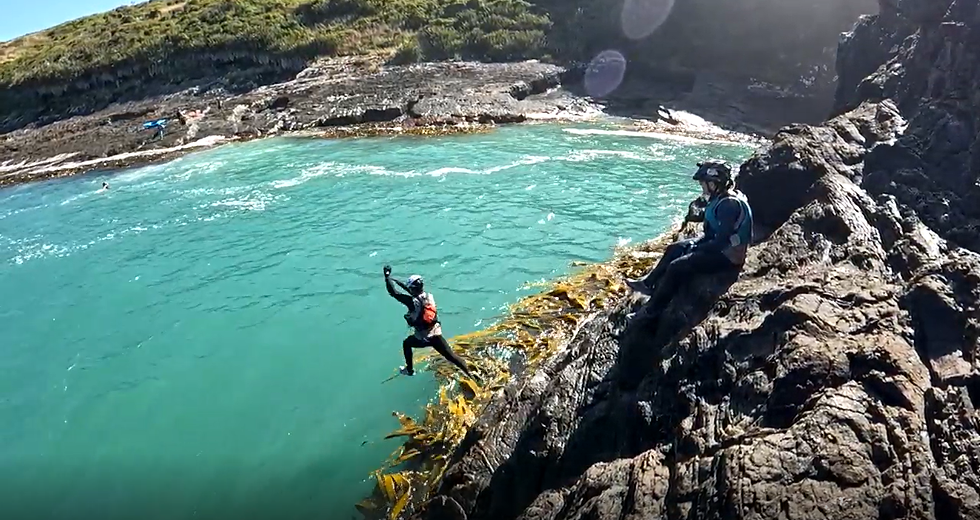


The rest of the coasteering section was less dramatic, but still insanely beautiful and surreal. Now, looking back, I want to do it again! I’m not sure if I needed all the support I got, but that might just be what makes me feel empowered enough to want to do it again.
I’ve done something that truly scared me and came out with a better appreciation for risk itself. I feel like I can conquer the world! More importantly, I feel like being given the opportunity to take such a risk was a gift. Thank you, MAGNIficent! You outdid yourself!

Hardest Hike-a-Bike Ever:
Talking about outdoing yourself… there is one final challenge worth mentioning. The hike-a-bike near the end of the race was yet another “I-can’t-believe-I-am-able-to-do-this” leg (Stage 9 – Bike (a-hike) to Beaumont, 24 km/15 miles, 1000 m/3281 ft).
It wasn’t exactly technical, but it required a LONG, STEEEEEEP slog up a narrow trail with your bike for more than 3000 vertical feet. Making matters worse, we had already been up AND down this mountain in the previous stage on foot, so we knew what we were in for and we had time to dread it.
It was so steep that there was really no good solution other than carrying your bike on your shoulders… for hours. Occasionally, you had to squirm around and duck under or around a tree or two. The view helped, but it didn't ease the sheer effort it took.
Similar to last year’s bike with packrafts, it reset my gauge for what “hard” really is. This was HARD. I will be putting this on my list of very hard things that I didn’t know I could do… but now I do.


Real Life Reflections:
So, as I reflect, I turn back to “real” life. Adventure racing always has a way of teaching you things. Sometimes, it’s small and concrete, like the value of swapping a bothy bag for a real tent. Other times, it’s much bigger.
This race taught me the value of taking a risk. I’ve learned this lesson before, but it hit me again in such a powerful way at exactly the right moment in my “real” life.
Risks might look entirely different to Trey, but who am I to withhold his right to take them? He deserves to feel scared. He deserves the opportunity to fail. He deserves to feel supported. He deserves to feel triumphant.

He has already passed his “swim test.” He attended an independent living retreat a few months ago and surprised us with all that he was able to do. He came home more talkative and confident. He was happy and trying new things.
At his new apartment, his roommate, who also has a disability, will be his "teammate". They will be examples for each other on how to do things.
He will also have a “safety team” at his new apartment, with staff living on the premises. He can call them at any time. They will check in and provide whatever support he may need.
And of course, there will be his dad and me whenever he needs to hit the SOS button. We’ll “helicopter” in if needed.
So much of me wants to take away all of the risk (really for all 3 of my kids). I want to shelter and protect Trey forever. But at what cost? Like I said in the beginning, the truth is, with someone always protecting you, there is little room for growth.
It reminds me of when my mom drove with me from Denver to Tallahassee so I could get my master’s degree at Florida State University. With 'Tallahassee or Bust' written on the back windsheild with soap, we drove my Subaru station wagon, packed to the hilt, to a foreign land where people talked funny. After I got settled, I dropped her off at the bus station to ride the Greyhound bus all the way back home.
She was the wind beneath my wings (still is). She helped me take risks even when success wasn’t guaranteed. She enabled me to explore what I could do with my life. In fact, I never ended up working in my field of study, music therapy. But in that “failure,” I met the first people with Down syndrome whom I would get to know through providing music therapy to students with special needs. Who would have thought back then that my life would be so directly touched by this genetic condition?
I am hoping Trey will find success. I hope he grows beyond what both he and I can imagine. I hope he will feel the same exhilaration I felt after this race, “I can conquer the world!”
I am truly grateful to the MAGNIficent 2 for teaching me, at age 53, that taking risks is still a valuable endeavor. Taking risks is also both a right and a privilege. It takes the right challenge, the right teammates, and the right safety crew on hand to make it possible.
Maybe both Trey and I will progress to needing less support. For now, I am confident that giving Trey the dignity of risk is the right thing to do.
If you’ve hung in there this long, consider what risk you want to take this year. How can you broaden your frame of reference? Or better yet, how you can help someone else broaden their frame of reference?
I know I will continue swim training. Who knows. One day, I might even like it! And, maybe I’ll start to like it before the World Championship in Corsica rolls around in October.
Thank you!
Thank you to my awesome teammates: Chip Dodd, David Grabiner and Nick Hurff. You guys are tough, smart, skilled, kind, funny and so much more! Thanks for taking a chance on me! We did it!! I’m so proud of us and our teamwork! (We finished 13th out of 30 teams and we were the top US team.)

Thank you to the MAGNIficent team! You created an unforgettable experience. The course challenged us, the scenery amazed us, the safety crew and volunteers cared for us, and the media team captured the beauty and the intensity. Incredible work! I feel honored to have been gifted this race from you.


I found this article very informative because it highlights the importance of working with experienced contractors for both small and large renovations. Proper planning leads to better results and fewer unexpected issues. Anyone searching for Generalized Contracting Services near me will find these recommendations helpful before starting a project.
This article offers useful reminders about maintaining a healthy home. Consistent carpet cleaning helps protect carpet fibers while improving the overall appearance and comfort of indoor spaces.